
What Your Form Score Means: Reading the 0–100
7 min read
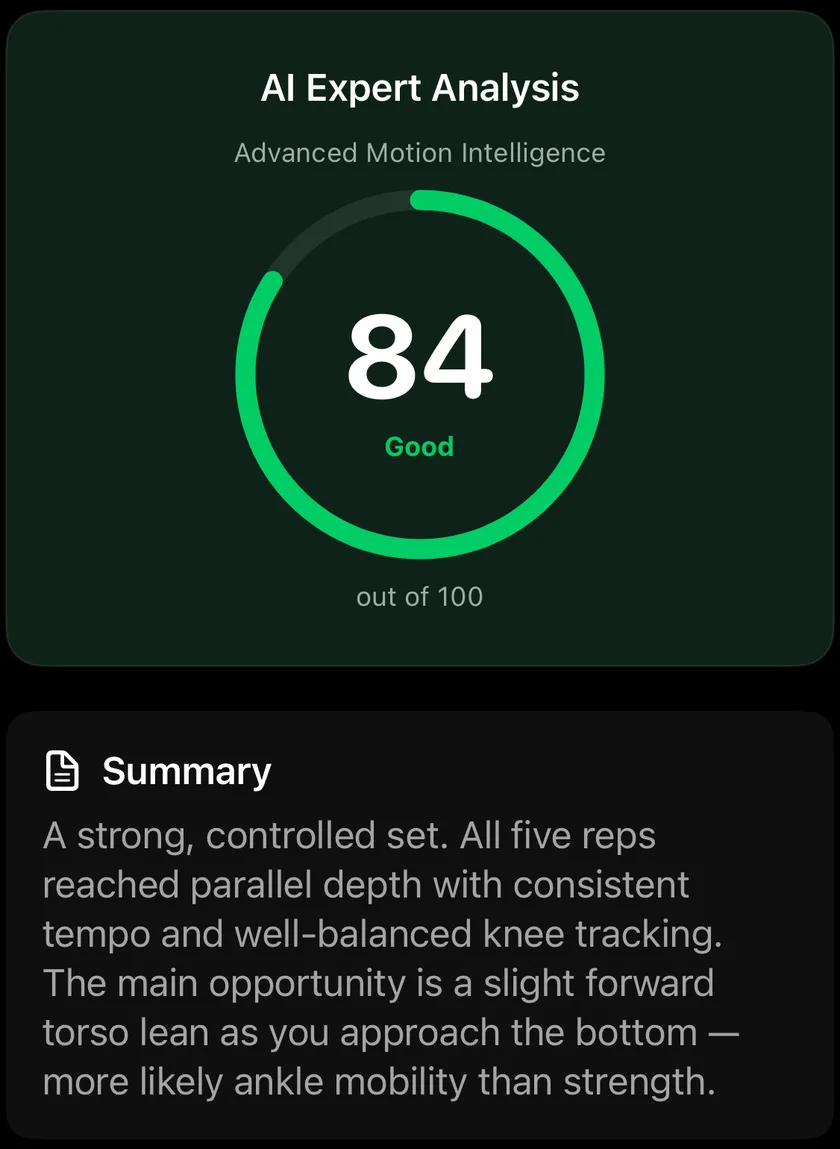
Film a set, and FormLens's AI analysis sums it up in a single number — your Form Score, from 0 to 100. Here's where that number comes from, what the bands mean, how to read the breakdown on the Charts tab, why it moves between sets, and how to raise it without chasing the number for its own sake.
Where the number comes from
- Measured on your phone. FormLens tracks your joints through the video, counts your reps and measures each one — for a squat, your lowest knee angle and the difference between your left and right knees; for a deadlift, how far your hips extend at the top. The video never leaves your phone; only those joint positions and measurements are sent for coaching.
- Scored from the numbers. An AI coach on FormLens's servers reads those measurements and turns them into the 0–100 score, a short summary and the one fix that matters most.
So the score is a judgement built on measurements, not a reading off a ruler — and it's only as good as the measurements under it. That's why filming the same way every time matters so much (how to film your lifts).
What's measured depends on the lift
| Lift | Measured from your video | Score breakdown |
|---|---|---|
| Squat | Depth (lowest knee angle), left/right knee balance, heel lift, stance | Depth · Symmetry · Consistency · Tempo |
| Bench press | Elbow depth, left/right elbow balance, elbow flare | Depth · Symmetry · Consistency · Tempo |
| Deadlift | Hip extension and lockout, torso angle | Lockout · Consistency · Tempo |
| Overhead press | Elbow lockout, hip drift | Lockout · Consistency · Tempo |
| Running | Cadence, bounce, flight time, shin angle at landing | Shown on gauges instead of bars |
Each lift is judged on what can honestly be measured for it. A deadlift has no symmetry bar because a side-on camera can't see both legs, and no depth bar because a hinge is judged on lockout; a squat has no lockout bar. Because each lift is measured on different things, a squat score and a deadlift score aren't directly comparable.
What the bands mean
- Needs workUnder 60
- Fair60–74
- Good75–89
- Excellent90–100
- 90 and up — Excellent. The lift looks the way it should, rep after rep. Keep the setup and add load carefully.
- 75 to 89 — Good. Solid, with something to tidy. The coach's fix and the breakdown's shortest bar are where to look.
- 60 to 74 — Fair. A clear weak link. Fix it before you add weight.
- Under 60 — Needs work. Lighten the load and rebuild the pattern, starting with the one fix the coach names.
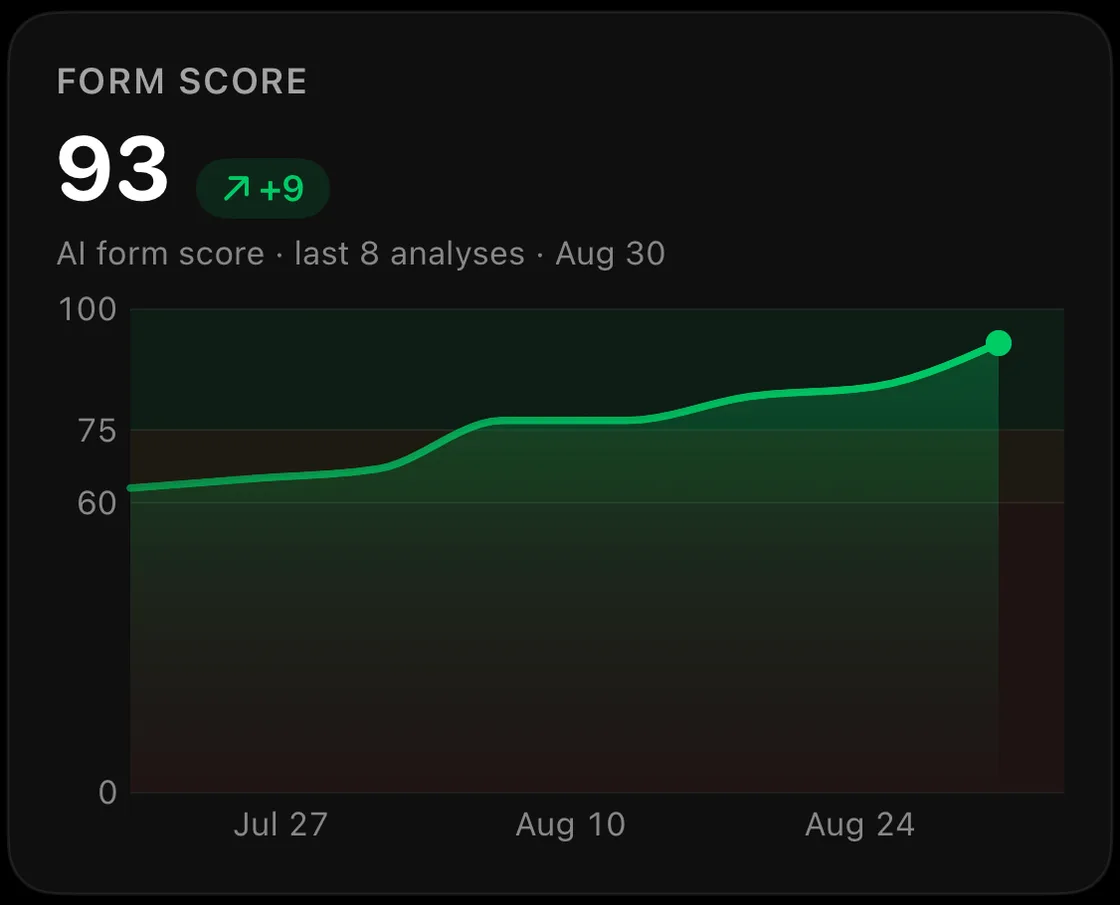
The trend chart shades the same zones behind your line, so you can see at a glance whether your recent sets sit in the green, in the gold or below.
Reading the breakdown
On the results screen's Charts tab, the Score Breakdown shows how the set did on each measured part. The bars are worked out on your phone from the same rep measurements the AI coach reads — they aren't a formula for the score, but they show where the set held up and where it slipped. Each bar is a percentage for the set:
- Depth (squat, bench press): the share of reps that reached depth. Four of five squats below the 90° line is 80%.
- Lockout (deadlift, overhead press): the share of reps that finished fully extended — 165° or more at the hip or elbow.
- Symmetry (squat, bench press): the share of reps where left and right stayed within the limit — 10° of knee angle on the squat, 15° of elbow angle on the bench.
- Consistency: how closely your reps match each other at the bottom (or top) of the movement. Needs at least two reps.
- Tempo: how steady your rep rhythm is. Appears on sets of three reps or more.
The shortest bar points at the weakest part of the set — start there. When it's under 75%, the chart names it for you. The charts next to it show each filmed rep — depth per rep, left/right difference per rep — so you can see whether a set was clean until rep four and then came apart.
Why your score moves
- Your technique changed. The reason you're filming.
- Load and fatigue. Heavier sets and the last reps of a hard set usually score lower. Compare like with like.
- Filming. A different angle, height or distance changes the measurements under the score, so a new camera spot can move the number even when your lift didn't.
- Rep count. A two-rep set has no tempo bar and a single rep has no consistency bar, so there's less to judge from.
- Judgement. Because an AI model sets the final number, two very similar sets can land a few points apart. Read the trend across several sessions, not single-point moves.
Self-test: how steady is your setup?
Film two sets of the same weight back to back without moving the phone. If the scores are close, your setup is consistent and changes over the coming weeks mean something. If they're far apart, fix the filming before reading anything into the number.
Before you compare two scores
- Same lift — each lift is measured on different things
- Same camera spot, height and distance
- Similar load and effort — not a warm-up set against a top set
- Three or more reps, so consistency and tempo are both measured
- Your whole body in frame, as last time
- A few sessions of trend, not one pair of numbers
How to raise it
- Lock in your filming setup — same spot, same height, same angle (here's how).
- Start with the one fix the coach names. Don't try to change three things at once.
- Use the breakdown to confirm it. The shortest bar should grow as the fix takes hold.
- Drop the load 10–20% if your last reps fall apart, and build back up once every rep looks the same.
- Practise between filmed sets — drills from the guides below, or the corrective plan FormLens builds from your weak points (Pro).
- Re-film after a week or two at the same weight and compare.
Guides for the most common fixes: squat depth, knees caving in, heels lifting, deadlift setup, bench press, elbow flare, overhead press and overstriding.
What the score isn't
- Not a safety rating. FormLens is a training aid, not a medical device. A high score doesn't mean a lift is safe for you, and a low one doesn't mean you're injured.
- Not everything. Some faults aren't auto-flagged yet — knee cave, butt wink and lower-back rounding among them. Replay the clip with the skeleton overlay for those.
- Not a meet judge. FormLens's depth line is a 90° knee angle, not the powerlifting hip-crease rule.
- Not a leaderboard. Bodies differ. Your score is most useful compared with your own earlier sets.
FAQ
What's a good form score?
75 or above is Good and 90 or above is Excellent. More useful than any single score is your trend: the same lift, filmed the same way, moving up over the weeks.
Why did my score drop when I added weight?
Heavier sets are harder to move well, so a small drop is normal. A big drop usually means the weight is ahead of your technique — the breakdown shows which part slipped.
Is the score calculated on my phone?
The measurements are, and so are the Score Breakdown bars. FormLens measures your reps on your iPhone and sends only the joint positions and measurements — never the video — to its servers, where an AI model turns them into the score and coaching.
Do sets I only log get a form score?
No. Only sets you film get a form score. Logged sets — including workouts you import from Hevy or Strong — feed your training history, PRs and charts.
Can I compare my score with a friend's?
Loosely at best. Different bodies, cameras and gyms change the measurements. Compare with your own earlier sets.
How many analyses do I get for free?
The free plan includes one full AI analysis a month. FormLens Pro removes the limit.
Educational only — not medical advice. FormLens is a training aid, not a medical device; measurements are estimates from a single camera. If something hurts, see a physio or doctor. Terms of Use
First published · Last updated · By FormLens